
I voted for Ronald Reagan twice to be president.
The next time I could vote, I voted for Jesse Jackson.
If I was to write the story of my spiritual, social, and political transformation in two short sentences, those two would be it. Those two sentences are the metaphor for a social transformation that continues inside of me, even to this day.
This essay is the story of that journey. And I want to tell it because:
1. I wasn’t always this way.
2. My own story, I have to hope, is potentially instructive to other White men, and to those who love them.
I wasn’t always “Liberal.”
I wasn’t always “Progressive.”
Anything you think you’ve known about me in these past few decades?
Well, it’s been a journey and you probably wouldn’t recognize either the High School or College me.
White men today tend to be dominantly conservative and Republican, both religiously and politically. And so, my primary “audience” here is other White men, but I certainly welcome any and all who wonder about how White men might, “evolve” on issues of issues of equality, justice, and inclusion.
Because of my very public adult identity today, sharing some of this feels very vulnerable and embarrassing. Those of you know have only known me as a progressive minister and activist may be disturbed by some of the following.
I suppose my overall point in writing it is that I believe very strongly “conversion” as a spiritual progress. Liberals are sometimes lambasted for not believing in repentance and conversion. But I believe it in strongly, and I believe the story of my life speaks to it in profound ways.
And I wish to advocate for other men to take this journey too.
But, we Wesleyans always make it clear that we move toward greater “perfection,” not arrive at “once and for all.”
So, what follows is my own very long story of repentance and conversion, and how Jesse Jackson played a part it in.
Buckle up.
I grew up in very conservative Far North Dallas. Everybody I knew was a Republican. Everybody I knew was a “Conservative.” It was the the late 1970s and early 1980s. I graduated high school a year into Reagan’s first term. I was eighteen on election day, and so I voted for Ronald Reagan in my first election. It would have never occurred to me to vote for anyone else. I did not know any Democrats. I did not know any People of Color, although we had a few at Richardson High School where I was a student.
I was very active in my Methodist church young group. But we were most definitely not “liberal” by any means.
And we we also most definitely not evangelical or fundamentalist, either.
(I’m grateful to have completely avoided organized fundamentalist religion as an adherent, even though it was clearly growing at the time and Dallas was something of an epicenter…)
My sense is that most of the childhood Conservatives I knew considered themselves “moderate Republicans.” That was certain my Father…at least by that time.
He had been a rabid anti-communist in the 1950s. He went to anit-communist demonstrations as a young man. But Nixon’s faults had deeply troubled him. Nixon had burned him out on politics and social movements. By the time I was in high school…like most of the parents and children I knew…we were all “moderate Republicans.”
That followed me to college. I was still quite conservative. Ronald Reagan reigned supreme.
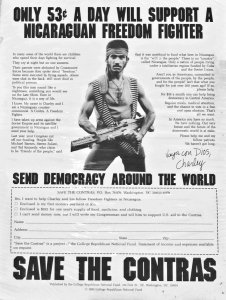 During my time in school, I had this poster of a Nicaraguan “contra” up on my wall of my dorm room. I thought it was funny, cheeky, brash like I dreamed of being.
Again, the older me is deeply ashamed to for you to see this. Many of my more progressive friends —especially my mentors who have been involved in the struggle for justice in Central America— may be horrified to see this poster, and imagine I had it on the wall of my dorm room, perhaps even during the same years they risked their lives to help Central Americans.
This is, as I’ve said, this is a part of my confession.
This is to help you see my journey.
Transparently, I did not think very deeply about the issues in Central America. My Father had been an anti-communist, therefore I was too.
I suppose, looking back, I thought the picture of this “contra” was cool…in a kind of “Apocalypse Now” way. Yes, that movie was supposed to be a meditation on the horrors of war. But as a high school kid, we had all seen it as “cool.”
This “freedom fighter” was like Martin Sheen, in my mind.
The honest truth is that it was all “image” and posturing. This in itself is only possible due to White privilege, of course. But it also makes me wonder about the young men in our day who seem to obsessed with images of war and violence. They don’t really know violence, but they are fascinated by it.
Again, I really didn’t know much about the war either, and I don’t think I sent money to support “Charley.”
I never attended College Republican meetings. But I was College Republican adjacent.
I didn’t know much about what Reagan was doing, or the illegality of supporting it through a poster like this. But in the early 1980s, this was the kind of thing young conservative men, in my conservative tribe, were doing back. I share this picture, because more than anything else I could write, it helps you see who I was then.
But….
During that time, I started attending church at First Methodist in Austin. I would eventually become very active there, serving as college class president for two years. Sunday after Sunday, I sat in the balcony of that church and heard Rev. Jack Heacock preach liberation theology sermons. Jack would preach about the struggle in Central America. He would talk about the poor people of El Salvador and Nicaragua.
I made fun of him in my head.
But another part of me was also listening.
It was theological and social “dissonance.”
I had two campus ministers who were incredibly important to me… Revs. Susan Sprague and Claudia Highbaugh.
They talked about their experiences as clergywomen…and Claudia about her experience as an African-American. Claudia, especially, listened to me. She loved and supported me…even as it was clear she thought I was young and naive. She didn’t judge me, but became my first real ministry mentor.
Claudia Highbaugh, an African-American clergywoman of another denomination, is the single most important reason I ended up in seminary and as a minister today.
Even quietly made fun of Jack Heacock’s tortured pronunciations of “Nicaragua” and “Honduras” I was also listening. It was seeping in. The theology of liberation was challenging me….angering me…pushing back on my little conservative, White male bubble. I took the Contra poster down, and started to question my values, even as I was afraid to admit that to anyone, publicly.
But by the time of the 1984 election, things were stiring inside me.
I believe it would be fair to say I was becoming disaffected with Republican social views on any number of issues.
And this is the key point: It was my Christian faith that led me to question those “Conservative” social views.
It was reading, studying, and really learning about what Jesus said about ministering with the poor, the marginalized, the outcast. It was really reading the Bible…the Gospels…and not just relying on Evangelical talking points.
On the West Mall –UT’s famous “free speech” area– I walked by tables full of information from people who believed very differently from me. I used to joke that there was “one of every kind of person” at UT. I now say “there was a club.”
In rows and rows of information tables, I learned about Christian evangelicals and fundamentalist, and also every mainline denomination too.
I learned about Israel and Palestine.
I learned about libertarians and socialists, Republicans and Democrats.
Yes, it’s probably where I got that “Charley” poster –and I now know much more about the Evangelical groups that were pushing such propaganda through Republican PACs.
But UT’s West Mall was also where I got an inclusive eduction that utlimately changed my world. Encountering and meeting people from all over the world, of different races and religions. Their very existence was challenging.
I was listening.
At one table, I remember how one “club” was talking about how Jesus wasn’t White. That was revolutionary too. I’d obviously known he was Jewish. But weren’t the Jews I knew pretty “White?”
(This was my thought…)
But as the group on the West Mall pushed, given the proximity to Africa, there was a much greater chance Jesus was African than Germanic. (That was the point of the group…) Whatever Jesus looked like in real life, he didn’t look anything like me. Jesus, the historical Jesus, wasn’t White.
That shifted things…
I also became fascinated with Jesse Jackson. Jackson was not only a politician, he was also an actual Christian preacher. Jackson spoke, theologically and politically. He used language of liberation that I now realize was very similar to the sermons I was hearing from Jack Heacock. Jackson’s campaign spoke of a “Rainbow Coalition,” and I was listening. HIs candidacy was the first time anyone seriously spoke to our multi-racial and multi-faith future.
(A future we have still not realized, decades later…)
He was talking about a coalition of African-Americans, yes…but also of White, Brown, Women….the gay community…
I was fascinated because not only was it so much more diverse than anything I’d ever experienced in my White-conservative life, but also because included a place for me.
The Rainbow Coalition, I realized, was like the West Mall.
It was a “club” of everyone.
It was a theology and politics in action.
It was very appealing.
Jesse Jackson came to UT Austin quite a lot during primary season.
I remember shaking his hand on a rope line at the “East Mall.”
And, I remember hearing him speak at the Student Union.
It was November 22, 1983. My friend Ed (another White guy) and I had decided to go and see Jesse speak. (I recently obtained a copy of the Daily Texan write up of the day, to insure that I was not exaggerating what had happened. I’m happy to say that the write up confirms my hazy memory…)
Looking back, that day changed my life.

We had seats back halfway back on the left side of the auditorium. It was PACKED to overflowing. The Daily Texan says there were 1,200 in the auditorium, and many more outside the closed doors.
For fear of a riot, the organizers had closed the doors. As Jackson took the stage, 500 more students pounded on the doors, rattling them and making a commotion over which Jackson could not heard. The doors were glass, and you could see the huge crowd…and how they were POUNDING on those doors and yelling.
I had never been in a situation like that. It felt like it might turn violent.
Jackson stopped his speech, walked down the long aisle (much to the chagrin of his own security and Secret Service detail) and opened the back doors. I could not hear what he said, but he was clearly addressing the crowd outside in the halls.
It became clear he was trying to get them to calm down enough so that the doors could be left open for all to hear.
The crowd agreed. The doors were opened so that all could hear and be included.
Jackson came back to the front of the room and re-started his speech.
I thought to myself, “Who IS this guy?!!”
Who has the power to confidently wade into that kind of tense situation, to diffuse it, and to all the while, keep his cool?
I’d never seen anything like it.
Again, I was so naive that I had no idea of his connection to Dr. King and the great civil rights struggle of the 1960s.
Jackson led the crowd in the “I am somebody” chant. And Jackson connected what he was doing with the struggle for Civil Rights in the 1960s.
The Daily Texan cites several quotes from his speech that day…
“In the 1960s we could not use the Woolworth, we could not use hotels and motels and students risked their lives to make America, America for everybody. That generation was great….This generation must never give up its right to dream.”
I was mesmerized.
Here was a man who was inspiring people in a way I had never seen from any politician or preacher. He was talking about a multi-racial, Rainbow coalition…and one that might even have a place for ME. White men would clearly not lead this coalition (Clearly a Black man was the leader….) but that the invitation he extended was to everyone…genuinely everyone.
That was revolutionary.
And the image of Jesse Jackson….walking to the back of that room…opening those doors…calming that crowd….that moment has stayed for me for three decades.
“Opening the doors for everyone…”
This vision —theologically, spiritually, socially— has been the primary calling of my life ever day since.
Did I vote for a Democrat in the next election?
Did I suddenly identify as a “liberal?”
No.
I did not vote for Walter Mondale.
Again, I will be brutally honest about myself.
Mondale was boring.
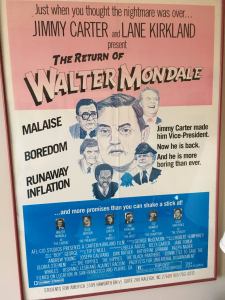 I could not imagine voting for somebody as boring as Walter Mondale. In fact, those same college Republicans —ever able to “spin” opinion– created this poster which also hung on my wall in the months prior to the 1984 election. Again, I’m a bit ashamed of this poster now, but the images helps you see where I was.
The main line that I resonated with was “he’s more boring than ever…”
Again, I am not proud of this. I am not proud of fact that I allowed something so shallow to affect my political vote. I was attracted to what Jesse Jackson said. But Jackson hadn’t won the nomination, and I could not vote for such a boring guy.
This is the level of thought that I put into my vote.
But, friends, I was stirred up…by Rev. Claudia Highbaugh…by Rev. Jack Heacock…by Jesse Jackson…Something was changing.
It would break open on election night, 1984…a night I mark as my own personal socio-political earthquake.
That night, that same friend (Ed) and I decided to go see the a college Republican celebration at the Texas Union. (Again, we didn’t really attend these things regularly. But we were politically and socially curious kids…)
Walter Mondale had been crushed by Reagan that night.
And I had voted for Reagan once again.
We walked up to the bar that was in the ground floor of the Student Union (the drinking age was eighteen). And there —watching the returns on a first-generation big screen TV— were a bunch of blue blazered, khaki and top-sider wearing, college Republicans. They were mostly young White men, they were drinking a lot of beer, and they were yelling lustily at the results.
I cannot describe for you now just how disturbing this suddenly felt to me in that moment.
A feeling of intense revulsion and confusion washed overe me to watch how these young, White college republicans were celebrating.
Reagan had won in a landslide. Everybody knew he was going to win in a landslide. (Remember: “Mondale was boring.”)
But these guys were shouting like a high school football team that just sacked the Dallas Cowboys quaterback.
Like they had somehow been the underdogs.
Like they had almost lost, and this was some miraculous comback win.
There was a lustiness, to this crowd.
They felt like soldiers, putting a head on a pike outside the castle.
“It was a LANDSLIDE, for Christsake,” I thought to myself….
“What the hell?”
There was something about that moment that broke me.
Again, the reaction just felt so off, so privileged and ridulously boastful for so obvious a win.
This should have been my tribe. I should have been right there in the midst of their testosterone-fueled celebration. But I watched them from the hallway, I thought….
“This is not my tribe…not any more…”
I was suddeny no longer “cool” with that kind of reaction to landslide of that magnitude, or laughing at Walter Mondale, or making fun of Jesse Jackson and Black people. I was suddenly embarrassed by my Contra poster….that Mondale poster…all of it.
(All of it probably provided by this very group)
“This is not my tribe…”
It was not a verbal thought, it was a feeling.
I knew it in an instant.
I knew I had changed.
I knew I would never go back to that group and that room.
But, immediately there was a new problem…
If they are not my tribe, who was?
Jackson had lost, and it didn’t seem like the Democrats were in a mood to support him.
So, who were my people?
Where was my place?
I didn’t have one.
I felt adrift and confused.
The next Fall I would be at Perkins School of Theology, and I started to discover the answer.
(Actually, what came first was having my heart broken open by a girlfriend who dumped me. That helped break me open for this journey, for sure…)
Now, at Perkins, I wasn’t just hearing Jack Heacock preach on libertion theology, I was studying it.
I was writing papers on Jon Sobrino and the Central American theology I had previously mocked.
Now, it made sense to me.
My first year study group gave me a cadre of diverse friends. We intentionally designed a group with women, a gay man, and an African-American man. And in that group, we didn’t just “study.” We wrestled with our theology, our identity, our power, gender, race. That group prayed together. Argued. Got in each other’s face. Pushed each other. Sought to understand each other.
I was listening…I was growing.
I became a Hall Director in the Residence Halls. I remember specific two events that transformed my social views even more.
One was an “in service” where Rev. Michael Piazza, then of Cathedral of Hope, spoke to our residence hall staff. It opened my eyes to the plight of the gay and lesbian community in the 1980s, and how the Reagan administration had done slow-moving and harmful damage.
Another seminal moment was a two-day racism training with Dr. Charles King. Dr. King was a nationally known trainer in race-relations. His method (I later learned) was to push, cajole and even berate White participants in his seminar. To the point at which he intentionally made them angry. He then was able to show those White participants that our emotional reaction was exactly like the reaction of POC to White Supremacy. (In those days, nobody used either of those last two terms…)
A write-up I recently found online has Dr. King explaining his process this way:
“I have manipulated you. I have cut you off, I oppressed you, not let you speak. I made everything go according to my system. It dehumanizes a person. You felt guilt, shame and anger you didn’t show.You slowly lose your dignity . . .
Again, we didn’t use the words “White Supremacy.” But that’s exactly what he was modeling for us. For a few short minutes, he put us White people in the position of seeing how White Supremacy feels.
Again, scales fell off my eyes. My world was rocked. My knees buckled.
“Oh, crap,” I said.
And in the midst of this, I first met Dr. Bill McElvaney.
If you know me at all, you’ve heard me speak of just how important Rev. Bill McElvaney has been to my life. Next to my Father, he is the most important man I’ve ever known. Bill was the man who –more than anyone else– showed me the way to a new “tribe.” He modeled, he lived in his very being, what it means to be a different kind of White man; at exacly the moment in my life when I needed such a mentor.
Bill had his own story —a similar story of transformation— that captivated me and gave me hope, and he (as I am trying to do here) was transparent in sharing it.
Bill had moved from being a young conservative college student at SMU, the scion of a wealthy Highland Park family, who defended his fraternity’s segregationist policy in the 1950s; to eventually becoming the lone White minister marching in MLK’s Poor People’s March from Grand Prairie to Dallas in 1968. Bill was also compassionated and committed to real justice for Central Americans, and the LGBTQ community.
He became my spiritual Father, and a hopeful roadmap for all I might become in life and ministry.
I have joked for many years that “Bill McElvaney showed me that you could be a White man from North Dallas, and turn out OK…”
That’s not really a joke. There’s a sense in which it’s literally true, and that my fear of no longer having a tribe meant that there was literally no “option” for a White, North Dallas boy. Because, given what I’d more recently seen of the dangerously mysogenistic, racist tendencies of so many White men?
There were times when I wondered “is there even hope for us White Men?” (Some are asking similar questions today…which I shall get to…)
I desperately needed the hopefulness of Bill McElvaney’s confessional journey, so that I could take my own confessional journey, to give me hope…to give me a roadmap. (This is what mentors are supposed to do for us, of course…)
And so it was that my theology, my politics, my entire cultural vision shifted.
I had a new vision of what it meant to be a White man, and perhaps as importantly, how I fit in relation to everyone else around me.
I had new White male role models, and genuinely deep friendship with POC, the LGBTQ community, and the poor.
I’d had experiences of my own privilege and power that had humbled me.
(Some of which, I have not shared here for brevity…)
And so, when it was time to vote in the 1988 primary, I proudly voted for Jesse Jackson.
And let me pause here.
Having told the story, let me not again, just how revolutionary this was.
Again, everyone I’d ever known from my “home” (which was, of course, just miles away from Perkins…) was still a Republican.
All my high school friends.
All my family.
Many were conservative or evangelical Christians.
Some of them, no doubt, would have been like those testoreone fueled guys on election night ’84.
They would have made fun of Jackson…and me, no doubt.
This moment –voting for Jesse Jackson– was more than pulling a lever. It was a “break” with every White man I had known growing up. It felt like the right thing to do.
But now, we must talk clearly about TRIBES…and how disorienting a loss of tribe is for anyone.
Because, in that moment, I felt alone, too. Not the confused alone-ness of 1984. But I still felt pretty weird, as what we now call a straight, CIS-gendered White man.
Now, decades later, I feel powerfully surrounded and blessed by progressive friends and family today, and that “tribe”now inspires me.
But in that moment? Pulling that level… (“Democrat”… “Jesse Jackson”…) also felt like betrayal of everything my Father and my “tribe” had ever taught me.
We are all tribal, to one extent or another. Even White men. The trouble, of course, is that White Men so often believe their tribe isn’t a tribe at all.
Too many White Men believe their “tribe” is just “reality.”
White men who fail to internalize this in a healthy way are incredibly lethal to everyone else.
Here’s what “everybody else” has taught me over the years: Whenever we leave the tribe of our birth, it can be disorienting.
Some folks leave their childhood religious traditions and join a new one; and even if the newer beliefs are closer to their core personhood, they still sometimes feel guilty for leaving the old faith.
(This is especially true for Catholics and Evangelicals…and partly explains why it’s harder to move from those two groups to anything else, than it is for Mainline Protestants to jump around)
Talking with friends of Color, my undersatnding is that sometimes when they move into the White world, there is a disorienting sense that comes, and a feeling they have betrayed their culture to live in the larger world. (Sometimes, their parents and families tell them this…)
Tribe, culture, religion, race…for all of us, these things go deep.
The specific cultural phenomenon of waking up from the dream of Whiteness can be disorienting.
Whiteness is an illusion. A creation of White Supremacy itself. White men must take this journey. (Please, don’t hear me hedging here).
But, I think it’s important for those who wish White Men to shift more than they do, and faster than they do, to understand just how how, it felt then like a betrayal of the White tribe then.
Again, I’m not asking for sympathy for White men, excusing them, or even asking for social change to slow to their pace. I am suggesting that this dynamic I am describe here –this lonely, disoriented feeling– explains part of what I believe it appears to be so much more difficult for many of White men to take the leap.
Because of the following…
We are trained to be White.
We are trained to be Male.
It’s in the water of our experience, how our families treat us, how women treat us, how POCs treat us, how we treat each other. It’s ASSUMED.
And we are trained…we are bred…to LEAD…and to expect that everyone else will follow us.
(Yes, I’ve started suggesting that White Men are “bred” to lead, perhaps like trainers breed racehorses.)
Yes, it’s all White supremacist. Of course it is.
But it’s also a deep cultural training that starts early in life that is assumed to be what your family, your church, your entire society, expects you to be.
And unlearning and unwinding it is often confusing.
Learning and unwinding it is a lifelong journey, filled with stops, starts, and plenty of cognitive dissonance.
Here’s what I know. Jesse Jackson was an inspiration to me –and to other White people my age– and not just to a generation of African-Americans.
Jesse Jackson was a life-raft off the wreck of Whiteness for me.
He helped row me toward a new place, socially, theologically, politically.
Existentially.
At that 1988 Democratic Convention, as he gave that incredible speech to rapturouse applause, he thundered “Keep Hope Alive…”
I wept.
For his courage and conviction…
For all the times I had (up to then) fought against that dream…
For how elusive his coalition and his dream clearly was…given how the election went that year.
It’s still far away, decades later, of course.
And that’s a point not to miss here either.
The Democrats of 1988 were not totally kind to Jesse Jackson.
Some privately mocked him, even as he brought huge numbers of African-American voters permantely into the Democratic Party. I am quite convinced that our nation, and specifically the Democratic Party, has not properly thanked Jesse Jackson for all he did to change the party’s trajectory
The coaltional nature of Democratic politics has not lessened in the ensueing years either. Democratic victories are now driven by fragile coaltions of African-Americans, the LGBTQ community, Latinos, Unions, Environmentalists, Young People…and others I’ll probably hear from because I didn’t mention them.
But that dream of Jesse Jackson?
Jesse’s Rainbow Coalition dream captured me then.
And it still does now.
It changed my life, was a key moment in my social conversion, and gave me hope.
And that’s the story, right there.
That’s the long journey of the first two sentences in this essay.
——————–
A lot of time as passed since then, and the journey never ends.
Being married to a Wise Latina has opened my eyes even further. I’ve heard her stories, and the stories of her family that have become a 30-year conversation in understanding what I do not understand.
I’m constantly learning what I don’t know. I still failing. I’m sill surprised by the way White privilege rears its head in my life today. I’ve listened to so many painful stories from church members and friends over the years —Women, People of Color, the LGBTQ community. They have taught me so much I did not know too.
For all I’ve written here, I could write five times as much about when I have failed to live up to this new identity I believe I now have. Overcoming, setting aside, the “breeding” I inherited as a child, that’s a lifelong journey.
But I tell this story I tell today because I am confident I am not alone.
Maybe you are a White man with a similar story.
Maybe you are a White man who is, right now, for the first time, considering that you might be looking for a new “tribe.”
I believe that when the Bible talks about “repentance” that this is what it is talking about. “Repentance” really means, “turning in a new way.” Whether the issue is homophobia, racism, sexism, White Supremacy…when the Bible speaks of “repentance,” that is the “turning in a new way” that believe it’s talking about.
It is, at the core, a spiritual process.
It takes constant work.
It’s not just feeling apologetic or teary. Repentence is what we do to live in a new way.
And, I want to be clear about this last part: As a non-evangelical, I do NOT believe it’s neither a “one and done” process, or a “in one blinding moment” process either.
In Wesleyan language, repentance is “going on to perfection,” and knowing that you might never get there completely. We are never done, especially in a society so completely dominated by White supremacy. The journey has not been of one, lightning bolt moment, that forever changed my life. Instead, it’s God working on me, through faith, to live as a different kind of White man…and as a White man who had no models….in the stories I am telling you here.
It’s this last point I want to end with.
White men need new models.
We need a path through which we can see ourselves in a new way…and through which we can behave in a new way. In a society that still affords us great privilege, it’s very hard to do. It’s easy to suggest “Well, all White men should just get off the stage.”
(I’ve actually had folks tell me this…)
For almost all of us, it’s still hard to see all the ways our privilege puts on “third base” and helps us believe we “hit a triple.”
(Ann was talking about ALL of us White men, really…not just George…)
Look, many of you know me as very different from the young man depicted in this essay. Some of you, I might surmise, may even be disturbed by some of what I’ve said here.
You perhaps know me as a progressive preacher who…
Was arrested in DC, in support of immigrants…
Performed Same Sex weddings in alleged violation of my church’s teaching…
Served on Planned Parenthood’s religions advisory committee…
Marches in a crap-ton of marches…and speaks out against White Supremacy…
Writes copiously on all these topics and more from a progressive spiritual point of view.
The point is that now and then my wife, looking at all this, asks: “How did you get this way?”
Well, it’s complicated.
It’s not just one moment.
It takes practice and re-learning…and re-unlearning.
But here is a final gratitude and final plea: Let’s find a space for more men to take this journey.
I thank God those around me have allowed me the space to grow, change, and move to a new place. I thank God that they have seen my “repentance” as genuine…and they have judged me by my actions, and not by my past.
I shudder to imagine what my life would be like if I had had the social media footprint of my college life, preserved for everyone to go back and judge today.
Our society certainly does not reward this kind of journey. In my own case, I rejected a “ladder” of increasingly larger church appointments, becasue I felt called to a different kind of ministry.
Perhaps this is why relatively few men feel either the desire, or the willingness, to take this journey?
Because, existentially, it can feel like giving up “everything” (it’s not) for an uncertain future (well, that’s true…).
As for me, I thank God for all the mentors and moments along the way…
For Revs. Susan Sprague, Claudia Highbaugh, and Jack Heacock…
For Jesse Jackson…
For Dr. Charles King and Rev. Michael Piazza…
For Rev. Bill McElvaney…and Dr. Zan Holmes…
For Dennise and all my social justice friends from the present day.
For small groups of men I know on similar journeys, with whom I can share stories and experiences.
They’ve allowed me “in” to a new “tribe” where I don’t have to act like the boss, or be in charge, but where I can —in the language of liberation theology— “accompany” everyone as we move forward together.
I like to call this new tribe: “The Tribe Of Everybody Else.”
I have an idea it’s what Jackson meant by The Rainbow Coalition.
I see my calling as being that of using the platform God has given me to do just this kind of ministry and sojourning.
I do wonder, and I leave you with this important question, however: What might have happened if I had been condemned along the way?
What might have happened to me if I hadn’t had all these mentors and s/heroes?
What might have happened to me, if compassionate people of color, Women, gay people, had not only pushed me out my comfort zone, and forgiven me when I badly stumbled?
I might be in a very different place.
I might be a Trump guy.
I can’t rule it out.
Marc Maron said something that’s stayed with me for months in his podcast with Brene Brown. It was a throw-away line that I’ve been pulled back to, time and time again.
He said that in modern America it seems that conservatives “never apologize” and that progressives “never forgive.”
There was something that struck me as deeply true about that.
On the Left, the only tribe I have any influence with at all, there can be a terribly unforgiving streak. White men deserve to be scorned for much of our history, and our current behavior. But it’s the “never” part of Maron’s line that gets me.
I’m no longer a Conservative. (and I haven’t been for decades now…) So I can’t speak to the “never apologize” part (although it rings true…).
But the “never forgive” part also rings true on the Left. There can be a hardness on the Left, and I wonder if (and here I’ll become a theologian) we can really move forward unless we can find space for White men to apologize…be given space to move to a new place….and also space to stumble and fail.
(Yes. All this has to be genuine…of course…)
Isn’t that what we all actually hope for?
That we all “progress” in some way, to some new place?
If Jesse Jackson’s Rainbow Coalition is ever to be fully realized, won’t there still be a place for White men at the table?
And if there’s not any place at the table for them, then have we really included everyone?
Progressivism, in its very nature, implies a “moving forward” to a “new place.” I believe in progress. But I also now believe the idea of “straight line” progress is a dangerous fantasy. I also am increasingly drawn to the theology of Rienhold Niebuhr, and his “Christian Realism.” Yes, Niebuhr stood against Nazism, but he also spoke against the weaknesses in our system too. That’s the “realism” part. Today, we need a realism that gives space for White men at the table, and also acknowledges that all constituent groups are made up of human being who can “Otherize” even members of their own team. None of us are perfect, and all of us have faults.
Yes, I support a future coalition, led by woman, POC, the LGBTQ community, and the poor. But, as a very honest church member told me once, “I don’t need a theology to tell my I’m good because I’m gay…I’m not bad or good because I’m gay…I’m just gay.”
Humans are humans.
If we have learned nothing else the past decade, it’s perhaps this last point. We are constantly learning and re-learning —at a societal and personal level— the lessons of how to live into a truly multi-racial, multi-gendered, multi-faith…diverse future.
As for me, I thank God that I am not judged (by those who know me today) by my actions in the past.
Maybe some will judge me now.
Maybe you will think my “conversion” has not been painful enough, or that this is all an exercise in “virtue signaling.”
Maybe all I know in the end, as I hope for our society’s future, is this…
Jesse Jackson had it right.
He did.
 I’m not talking about the vision of a specific political party or presidency. I’m talking that vision that captured so many of us back in the day…of a Rainbow Coalition –a conversation and a movement– with a room at the table for anyone with a heart of good will.
In the end —whomever we are—we all need some kind of hopeful models that we can aspire to…some kind of hopeful future that we can embrace that includes a place for us all, so that we can leave behind our past. Or at least, so we can move forward in some way.
All those years ago, Jesse Jackson was speaking to a kind of multi-racial, multi-gendered, multi-faith coalition that America is only NOW starting to make real. We haven’t made it real YET.
It has never yet been.
But that hopeful vision, which I saw in the primaries of 1988, is deeply threatening to some White men. It’s certainly threatening to White supremacy. And that is at the heart of much of the churn in our society, especially in today’s “Trumpism.”
I’m confident —nearing 100 percent certainty— that this is what’s created the phenomenon of Donald Trump. His moral licensing is giving permission to a new generation of White nationalism and racism that should disturb us all.
I don’t have all the answers.
(Maybe any of them…)
I know White supremacy will be a continuing challenge, and that it’s very existence could lead some to suggest White people be silenced completely and ushered of the stage.
If I may…and I say this very carefully…I think that would be a mistake. White men will still be in our society for the forseeable future, and it appears that at their most desperate they can be a deep danger to themselves and to everyone else. They have to hear messages, and permission, to explore the “Tribe of Everyone Else,” or they will never feel the courage to leave the tribe of White Men.
All I can tell you is that, decades ago now, Jesse Jackson spoke to me.
As I watched him open the doors of the UT Student Union ballroom, it was a glimpse of a powerful inclusion for everyone.
A place where the powerless are lifted up from hopelessness, and the powerful brought down from their “breeding” to lead and dominate.
That is the hopeful, and still unrealized, future of our nation.
Our future coalitions will undoubtedly be led by African-Americans, Women, members of the LGBTQ and Latinx communities, and many others. And that is good, and beautiful, and HOPEFUL.
So, to all of us whomever you are, whatever your politics, gender, ethnicity, sexual oriention, I would suggest to you…
Jesse Jackson had it right.
And, if you are a White man, I invite you to join me on this continuing journey of repentance and living in a new way.
If you are everyone else inside “The Tribe of Everyone Else,” when you can, I hope you might offer some of us your forgiveness as you see us White men living in a new way.
Or if the language of forgiveness makes no sense to you, I will commit to continuing with walk with you, to “accompanying” you, anyway.
Not in front, or behind, but beside you.
We’ll probably never call it the “Rainbow Coalition” again.
Jesus would call it “The Kingdom of God,” where the last are first, and the first shall last, where “Greeks and Jews,” and “Male and Female” are welcome, where Roman soldiers lay down their weapons, like White Men lay down their privilege.
Where ALL MEANS ALL…means, everyone.
It’s a spiritual, social, and theological vision, that still animates my life and calling today.
And I hope it will yours, too.
 WhenEFTalks
Great read. I loved this! Truly. And, thank you for showing us all what white men can aspire to. Thanks again!
Eric, thanks for sharing your evolution experience. I am one who has been blessed beyond measure by you, Denise and Maria. Your years at Northaven still bears beautiful fruit.